Independent machinery sourcing · Handover

meat processing equipment

Meat Processing Equipment Sourcing is an independent sourcing partner for dedicated meat processing equipment used in grinding and preparation rooms. Plant buyers send inlet condition, plate opening and destination so factories can return comparable wholesale quotes. This site does not run a slaughter or grinding plant and does not publish a market discount percentage.

Procurement scope on this landing page is a grinder family that accepts fresh meat or frozen blocks and discharges a specified particle size. Mixers, emulsifiers, stuffers and packaging machines stay outside this keyword landing unless a supplier lists them as optional extras on the same quotation.

Public pages such as JBT Marel COMBIgrind 280 (accessed 2026-09-17) list hopper volume in liters and plate openings in millimetres together with fresh-meat and frozen-block options. Those published figures are RFQ unit references, not a claim that this service sells that model or that hopper litres equal sustainable kg/h.

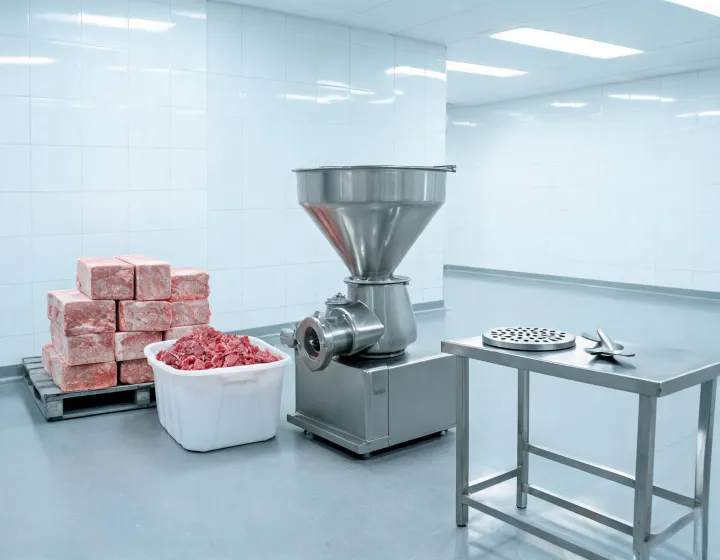
Stainless meat grinder hopper beside frozen blocks and a plate-and-knife set on a hygienic plant floor Request Factory Quotes

Choose a quotation route

Factories quote faster when the grinding duty is already written. If plate opening, knife count and feed temperature are still open, ask for selection support instead of treating the first brochure kg/h as a contract number.

Defined specification

Send species, inlet temperature, hopper loading method, plate opening (mm), knife arrangement, required particle size, connected load, three-phase supply, quantity and destination. Ask each factory to quote the same duty so machine, tooling and site lines can be compared.

Send requirements

Selection still open

If the plant has not chosen fresh versus frozen feed or has not locked particle size, use the sourcing steps page to list the unknowns. Do not treat a dual-knife option on a public datasheet as already included until the quotation names it.

Review sourcing steps

Changeover between grinding recipes

What changes between products?

Particle size, fat range and frozen-block size change plate opening, knife set and hopper loading rhythm. A recipe that runs as fresh trim at 2 °C cannot reuse the frozen-block trial without a new sample and a restated kg/h basis.

What must be cleaned or replaced?

Ask which product-contact parts unbolt for inspection: worm, plates, knives, bone-separation inserts and hopper lids. Heavy plate handling and storage space belong on the quotation if operators must swap sets between recipes.

How is the first good output verified?

Record product temperature before and after the demonstration, retained texture, and usable yield after the named plate. Throughput claims without the trial feed and plate opening are not comparable.

Questions before a factory demonstration

Will the grinder process fresh or frozen meat and at what inlet temperature?
  1. Representative sample

    Ship the same species, fat range and inlet temperature that the plant will run. Frozen blocks should match the stated dimensions; mixed leftover trim is not a substitute sample.

  2. Demonstration

    Ask which plate opening and knife arrangement will be fitted, how the hopper is loaded, and whether bone separation is active during the timed run.

  3. Acceptance record

    Write kg/h on the named feed, particle size after the plate, temperature rise, and who signs the FAT or SAT for the contracted machine only.

Which responsibilities remain with the equipment supplier and buyer?

The supplier confirms feasibility on the stated duty, lists included plates and knives, and names installation, training and spare parts that sit outside the base machine. The buyer owns process decisions, sanitation program approval and contract acceptance. This service coordinates comparable quotes; it does not accept the line on the buyer’s behalf.

Resolve grinding unknowns before ranking quotes

Discuss Your Requirements